From Idea to Live Product: How Park in Ghent Shows What AI Can Do When Vision Leads
There is a special kind of satisfaction in seeing a real product live on the internet. Not a mockup. Not a coming soon page. A working thing that solves a real problem for real people. That is exactly why Park in Ghent is such a fun example of what happens when you combine a clear idea with AI and a willingness to ship.
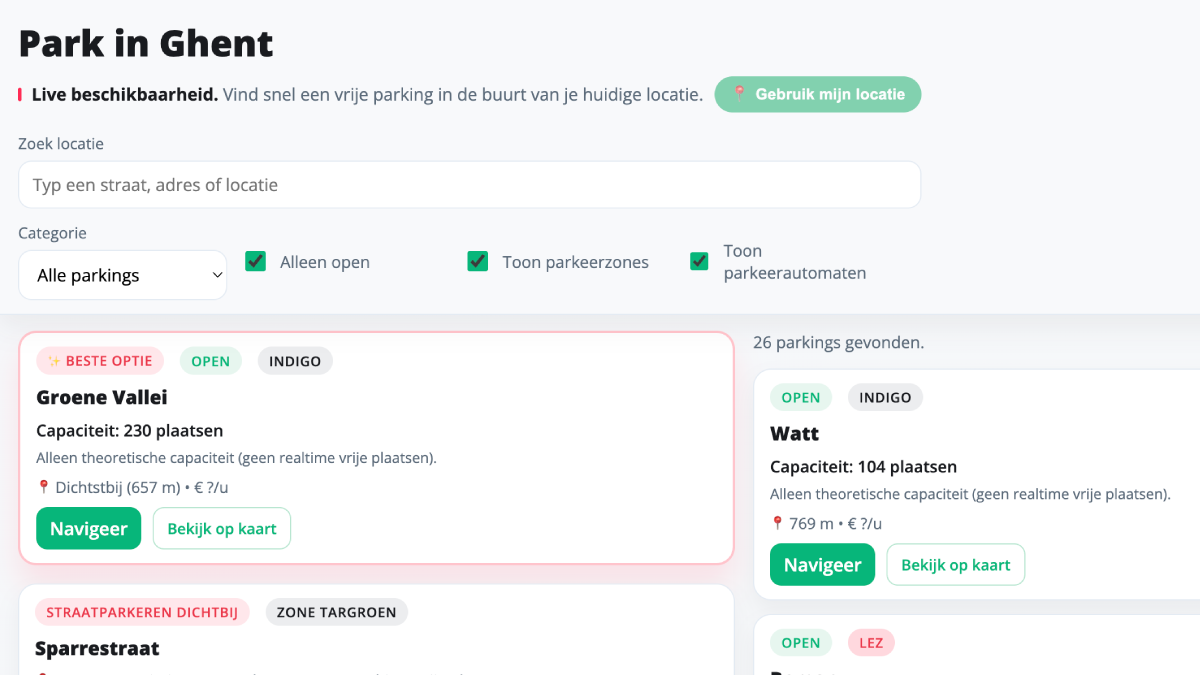
The idea itself is wonderfully practical: help people in Ghent find parking without the usual guessing, circling, muttering, and slow emotional collapse that begins around the third full garage. Instead of forcing drivers to bounce between random maps, signs, and hope, Park in Ghent brings the useful information together in one place. It shows live parking availability, helps users find nearby options based on their location, and surfaces the most relevant choice fast.
A Focused Tool With A Clear Job
What makes this project especially interesting is that it is not trying to be a giant platform with twelve dashboards and a pitch deck full of urban mobility disruption. It is a focused tool. Open the site, allow location access, and it starts doing something helpful immediately. That kind of product clarity is powerful, and AI becomes far more valuable when the destination is already clear.
The real takeaway is simple: AI is most impressive when paired with taste, direction, and decisiveness. Park in Ghent works because the vision is specific. Help people find parking in Ghent, quickly, on mobile, with live data, on a clean interface, and ship it for real. Once that vision exists, AI can accelerate nearly every step.
Lean Stack, Real Data
Under the hood, Park in Ghent is built as a lean static site using plain HTML, CSS, and JavaScript. That matters. There is no unnecessary complexity here. The app uses realtime parking data from the City of Ghent, displays it on a Leaflet map, calculates distance from the user, and highlights the best nearby option. It also supports location search through OpenStreetMap’s Nominatim service, which means users can search by address or place name instead of relying only on geolocation.
And it does more than list garages. The project also layers in practical extras that make it feel thought through rather than quickly assembled. There are parking categories, open now filtering, parking tariff zones, nearby parking meter locations, and even street parking information when available. It also merges in additional Indigo parking data, extending the usefulness of the app beyond a single feed. In other words, this is not just a map with dots. It is a small decision engine for people who want to park with less friction.
AI As A Force Multiplier
That is where AI shines. Not as a magical replacement for judgment, but as a force multiplier for execution. If you know the experience you want to create, AI can help you move from concept to implementation much faster. It can scaffold the interface, help structure the data flow, speed up debugging, refine copy, improve edge cases, and support the boring-but-critical work that usually slows projects down.
Things like cookie consent, privacy modals, mobile behavior, caching, filtering logic, and data normalization all still need to exist in a real product. AI helps get those details over the line.
Built To Operate, Not Just To Demo
The deployment story makes the lesson even clearer. Park in Ghent is not trapped on a laptop. It is set up
properly with GitHub, separate dev and main branches, automated deployments,
Cloudflare, Nginx, SSL, and a Hetzner VPS. That means the project is not just built, it is operational.
Changes can be tested on a dev domain and pushed to production cleanly. That is the difference between playing
with an idea and running one.
So yes, building a live project is easier than it used to be. Not because the work disappears, but because the distance between I have an idea and this is online and useful has become dramatically shorter. Park in Ghent is proof. A sharp concept, real data, a lightweight stack, and AI as a capable collaborator. That is not science fiction. That is just shipping.